03 / THYMIC IMMUNOMODULATOR
Thymosin Alpha-1: research overview
The most instructive arc on this site: a promising smaller trial, a larger and better-blinded one, and a result that did not survive the upgrade.
The short version
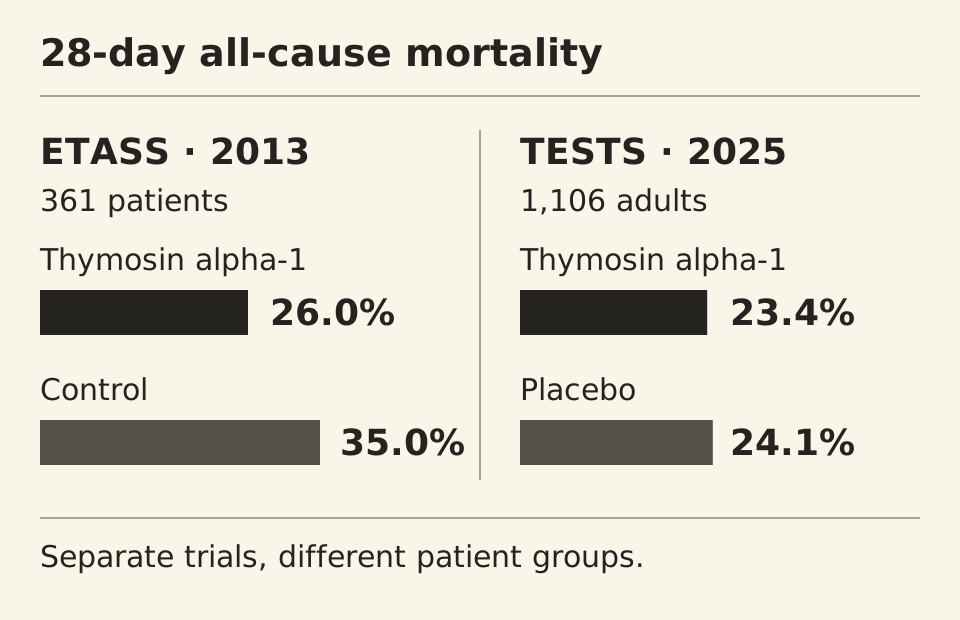
Thymosin alpha-1 is a natural immune-signalling peptide that is sold as a medicine in more than 35 countries and is not approved in the United States [14]. Its story is the clearest lesson on this site. In 2013 a trial in 361 people with severe sepsis found that fewer people died on the peptide than in the control group — 26 percent against 35 percent — but the result sat right on the edge of what counts as statistically convincing [17]. In 2025 a much larger trial repeated the question properly: 1,106 people, and neither the patients nor the doctors knew who was getting what. The difference vanished. Mortality was 23.4 percent against 24.1 percent [13]. The peptide did not change between 2013 and 2025. The quality of the test did. That is what a stronger design does to a weak signal, and it is why design is read before result.
What it is
Thymosin alpha-1 is a 28-amino-acid, N-terminally acetylated polypeptide cleaved in the body from a 113-amino-acid precursor, prothymosin alpha. It is highly acidic, contains no aromatic residues and no disulfide bonds, and the N-terminal acetylation is essential to its biological activity. The synthetic version used clinically is sequence-identical and is known generically as thymalfasin. It is classed as a thymic peptide and biological response modifier.
Its regulatory position is split. It has no United States marketing authorisation, and a comprehensive review of four decades of clinical literature reports approval as a drug in more than 35 other countries [14]. Some United States orphan-drug designations have existed historically for specific indications, but a designation is not a marketing approval and the two are frequently confused. The Food and Drug Administration has evaluated thymosin alpha-1-related bulk drug substances for pharmacy compounding and has not endorsed them, which reflects unresolved questions about identity, quality and clinical evidence for compounded use. Material obtained as research-grade peptide sits outside the regulated drug-quality chain entirely.
That split status creates a specific reading hazard. Dose ranges and outcome figures that circulate for this compound were generated in supervised clinical settings in countries where it is an approved medicine — the review reports a standard single subcutaneous dose in the range of 0.8 to 6.4 mg, with multiple-dose regimens of 1.6 to 16 mg over five to seven days [14]. Those are descriptions of approved clinical practice elsewhere, recorded here as literature. Extrapolating them to unregulated or self-administered use is not supported by the evidence and falls outside any approved indication.

How it works
Thymosin alpha-1 acts at the interface between innate and adaptive immunity. It signals through Toll-like receptors, notably TLR2 and TLR9, on dendritic cells and monocytes, promoting their maturation, interleukin-12 production and antigen presentation, which in turn drives T-cell maturation and a Th1-polarised response. In parallel it can engage the indoleamine 2,3-dioxygenase and tryptophan-catabolism pathway to generate regulatory T cells.
That dual action is the mechanistic reason the compound has been studied in such different conditions. In an immunosuppressed state it can restore effector immunity; in a hyperinflammatory state the regulatory arm can damp the response. A reappraisal of its role in cancer therapy positions it as an immunostimulatory adjuvant used in combination with chemotherapy and immunotherapy in melanoma, hepatocellular carcinoma and lung cancer, acting through dendritic cells and potentially helping convert an immunologically inert tumour into a responsive one while restoring mucosal homeostasis to mitigate checkpoint-inhibitor toxicity [16].
An appraiser should register what kind of claim that is. A mechanism that can plausibly explain benefit in both immunosuppression and hyperinflammation is a flexible mechanism, and flexibility is a mixed virtue in a hypothesis. A theory that can accommodate an effect in either direction is harder to falsify, which makes the clinical trial results carry more of the weight, not less.
What the research shows, by the design that produced it
ETASS, 2013 — randomised, multicentre, and single-blind. The ETASS trial enrolled 361 patients with severe sepsis and reported 28-day all-cause mortality of 26.0 percent in the thymosin alpha-1 group against 35.0 percent in controls, an absolute reduction of about nine percentage points [17]. Monocyte HLA-DR expression improved, which is a coherent mechanistic corroboration. Two features of this trial matter more than the headline. The first is that it was single-blind: participants were blinded, investigators were not. In a critical-care trial where a great many downstream decisions — escalation, withdrawal, supportive care intensity — rest on clinician judgement, an unblinded investigator is a live route for differential treatment between arms. The second is the statistics as reported: a nonstratified p-value of 0.062 and a log-rank p-value of 0.049 for the same comparison [17]. Two legitimate analyses of one dataset landed on opposite sides of the conventional 0.05 threshold. Whether this trial is described as positive or as non-significant depends entirely on which of its own p-values is quoted, which is a useful demonstration that a threshold is a convention rather than a fact about nature.
TESTS, 2025 — the confirmatory test. The TESTS trial was a multicentre, double-blinded, randomised, placebo-controlled phase 3 study in 1,106 adults with sepsis across 22 centres [13]. It found no statistically significant difference in 28-day all-cause mortality: 23.4 percent on thymosin alpha-1 against 24.1 percent on placebo, a hazard ratio of 0.99 with a 95 percent confidence interval of 0.77 to 1.27 and a p-value of 0.93 [13]. Every dimension of the design is an upgrade on ETASS — triple the sample, double blinding, a placebo control and a pre-specified primary endpoint that is a hard clinical event rather than a marker.
Reading the null correctly. A hazard ratio of 0.99 with an interval of 0.77 to 1.27 does not prove the peptide does nothing in sepsis. It says the data are most consistent with no effect while still admitting, at the edges of the interval, a reduction of up to about 23 percent or an increase of up to about 27 percent [13]. "Not demonstrated" and "excluded" are different verdicts, and confusing them is one of the most common errors in both directions — enthusiasts read a wide null as leaving the door open, and sceptics read it as closure. The correct reading is that the best available test of this question returned no signal, and the burden now sits with anyone claiming one.
Why pooling the earlier trials would not have helped. Before TESTS, positive but lower-quality sepsis trials had been combined in meta-analyses that looked favourable. The trial base in this literature is heterogeneous and often single-region, with many studies open-label or small, and meta-analyses repeatedly flagged moderate-to-high risk of bias while calling for larger blinded randomised trials. This is the central limitation of pooling: a meta-analysis increases the number of participants, but it does not repair the designs it is aggregating. If unblinded assessment inflates an effect in each contributing trial, pooling those trials produces a larger, more confident, and equally inflated estimate. Precision improves; accuracy does not. The only remedy was a properly blinded trial large enough to settle it, and when one was run the pooled expectation was not confirmed [13].
The COVID-19 cohort — a different design, a different weight. A retrospective review of 76 patients with severe COVID-19 reported significantly reduced mortality with thymosin alpha-1, 11.11 percent against 30.00 percent, and found the peptide increased blood T-cell numbers in patients with severe lymphocytopenia while reducing PD-1 and Tim-3 expression on CD8+ T cells, consistent with reversal of T-cell exhaustion [15]. The immunological findings are mechanistically informative. The mortality comparison is not randomised: patients were not allocated by chance, so who received the peptide was decided by clinicians using judgement about the patient in front of them. That is confounding by indication, and it can push an apparent effect in either direction depending on whether the sicker or the more salvageable patients were selected for treatment. The wider COVID-19 evidence is mixed, and a later systematic review of the literature found no statistically significant overall mortality benefit.
Reported effects, cautions and safety
What follows is anecdotal, not clinical evidence: it is a summary of self-reported community impressions, unmeasured and uncontrolled. The most commonly reported benefit is catching fewer respiratory infections over a season or shrugging them off faster, followed by faster recovery from a stretch of feeling run-down, a general sense of resilience, and steadier daytime energy during recovery from chronic illness. Many people report feeling nothing unusual at all and describe it as easy to tolerate. On the adverse side, mild redness, itching or brief stinging at the injection site is the single most common complaint; a minority describe a short-lived flu-like or achy day; a few mention a low-grade headache or tiredness. Two further reports are about circumstances rather than pharmacology: expense and difficulty of access, and worry that unregulated research-grade vials may be underdosed, mislabelled or not the peptide claimed. Notably, a common report is simply no perceived effect at all — which is unsurprising for an immune modulator whose action is biochemical rather than something a person would feel, and which is exactly why subjective impressions of "feeling more resilient" are a poor instrument for this compound and are highly vulnerable to expectation effects. Better-informed community members now temper expectations by pointing at the null phase 3 sepsis result.
The documented cautions are these. Efficacy expectations should be tempered by the null high-quality trial data: the largest and most rigorous sepsis trial found no significant mortality benefit [13], and a null result in a setting where smaller studies looked promising is a direct caution against assuming benefit elsewhere. As an immunostimulant that promotes dendritic-cell maturation and cytotoxic T-cell activity, it carries a theoretical caution in established autoimmune disease, and a further theoretical caution in solid-organ transplant recipients, whose immunosuppression is deliberate and whom a peptide that restores T-cell maturation could in principle work against. Dedicated pregnancy and lactation safety studies are absent from the literature, so there is no basis on which to characterise fetal or infant risk [14]. Injection-site reactions — local redness, itching, burning or discomfort — are the dominant expected adverse effect, with occasional transient flu-like symptoms and no documented organ toxicity at studied doses. And the compound is not approved for marketing in the United States, so research-grade material carries purity, content, sterility and identity risks that are independent of the molecule's own pharmacology.
Where it fits in Research Peptide Fundamentals
Thymosin alpha-1 earns its place on this site because it completes a cycle the other two compounds have not. Retatrutide's evidence has not reached the confirmatory rung. BPC-157's has not reached humans in any meaningful volume. Thymosin alpha-1's went the whole distance — promising smaller trial, enthusiastic secondary literature, pooled estimates, and then a large, blinded, placebo-controlled confirmatory trial — and the answer at the end was null [13][17].
That makes it the working answer to four of the appraisal questions at once. On blinding, ETASS and TESTS are as close to a controlled experiment on blinding itself as this literature offers: same compound, same condition, same primary endpoint, different rigour, different answer [13][17]. On p-values, ETASS's two competing figures show a threshold behaving like a convention rather than a boundary in nature [17]. On effect sizes and intervals, TESTS shows a null that is genuinely null without being a proof of inertness [13]. And on synthesis, the sepsis meta-analyses show why pooling weak trials produces a confident wrong answer rather than a strong right one.
One more distinction is worth carrying away. A null result in sepsis is not a null result for the molecule. Sepsis is a heterogeneous syndrome and a famously hostile setting in which many promising immunological interventions have failed; the signal in chronic viral hepatitis, where this peptide has its longest clinical history, rests on a different literature that the sepsis trial did not test. Generalising a trial's verdict beyond its own population and endpoint is a distinct error from misreading the trial, and it runs in both directions — positive results are over-extended just as often as negative ones.
Read against retatrutide, thymosin alpha-1 is the reason a phase 2 signal is treated as a hypothesis. Read against BPC-157, it is what a compound looks like after the test that BPC-157 has never had. The comparison page sets the three side by side.